
What should you expect before your first laser hair removal session?
Most people book a first laser hair removal appointment after months of thinking about it, and they arrive carrying a mix of accurate advice and secondhand rumor. The preparation itself is simple once someone explains the reasoning behind each rule, though the rules matter more than patients tend to expect. Skin that has been prepared properly takes the treatment well and settles quickly afterward, while skin that was waxed or tanned in the wrong window can turn a routine appointment into a rescheduled one.
This guide covers what happens at your consultation and how the weeks leading up to your appointment shape the result you get. It also walks through what the session feels like in the room and what your skin does in the days that follow, so nothing about the first visit catches you off guard.
Why does the consultation come first?
Every treatment plan begins with a provider looking at your skin and your hair rather than at a price sheet. Two variables drive the whole course of treatment: how much pigment sits in your skin, and how much sits in your hair. Your provider will assess your skin on the Fitzpatrick scale, note the color and coarseness of the hair in the area you want treated, then select a wavelength and an energy level that suit the pair.
Hormonal factors come up in the same conversation. Conditions such as polycystic ovary syndrome influence how quickly hair returns, and patients managing one usually need more sessions than the standard range suggests. Medications get reviewed here as well. Some antibiotics and a handful of common supplements make skin more sensitive to light, which changes either the settings or the timing of your first appointment.
Many providers also perform a small test patch during or shortly after the consultation, particularly for deeper skin tones. A few pulses on a discreet section of skin, followed by two or three days of observation, confirms that the settings your provider has in mind agree with your skin. The step adds a few days to the calendar and removes most of the guesswork.
How does the laser remove hair?
Laser hair removal works on a principle called selective photothermolysis. The device emits light at a wavelength that melanin absorbs far more readily than the surrounding tissue does. That light converts to heat inside the pigmented hair shaft, travels down to the follicle, and damages the structures responsible for producing new hair. Skin around the follicle stays comparatively cool, especially on platforms that spray a burst of coolant immediately before each pulse.
The catch is timing. Hair grows in cycles, and the laser reaches only those follicles that are actively growing, since those are the ones still firmly attached to the shaft carrying the heat downward. Research on facial laser hair reduction places roughly 56 to 76 percent of facial hairs in the active growth phase at any given moment, with each correctly performed session producing about a 20 percent reduction in the treated area (Journal of Clinical and Aesthetic Dermatology). Hairs resting below the surface on the day of your appointment simply wait for the next one, which is why a planned series spaced weeks apart outperforms any single visit.
How should you prepare in the weeks before your appointment?
Preparation runs on a countdown rather than a checklist you complete the night before. Seeing the timeline laid out makes it easier to schedule a first session around a vacation, around waxing appointments you may already have booked, and around the skincare routine you use every day.
When | What to do | Why it matters |
|---|---|---|
Four to six weeks before | Stop waxing or tweezing the treatment area | The laser needs an intact follicle with pigment inside it. Pulling hair out by the root leaves nothing for the light to target. |
Two to four weeks before | Keep the area out of direct sun and away from tanning beds or self tanner | Extra pigment in the skin competes with the hair for laser energy, which raises the risk of a burn or a pigment change. |
One week before | Pause retinoids and exfoliating acids on the area unless your provider says otherwise | These leave the surface thinner and more reactive to heat than it would normally be. |
24 to 48 hours before | Shave the area cleanly with a fresh blade | Hair above the skin scorches and pulls heat toward the surface. Shaving clears it while leaving the follicle intact underneath. |
Morning of your session | Arrive with clean skin and no deodorant or lotion on the area | Product residue interferes with the handpiece and with the cooling spray that protects your skin. |
The four-week rule tends to surprise patients who have relied on waxing for years. It is the one instruction people most often skip, and it is the one most likely to cost them a session. Everything else on the list protects your skin from taking more heat than it should.
Why does shaving replace waxing before laser?
Shaving is the preferred method because it clears hair at the surface while leaving the root and its pigment exactly where the laser can find them. Waxing, threading and epilating pull the entire hair out, which removes the target along with it. A follicle emptied by wax two days before your appointment has nothing inside it to absorb light, so that pulse accomplishes very little.
The stubble question comes up constantly. A close shave 24 to 48 hours before your session leaves a short, dark stub sitting in the follicle, which is what the device is looking for. Shaving the same morning is acceptable at most practices, though it can leave the skin slightly irritated before treatment begins. Shaving several days early lets the hair grow long enough at the surface to absorb energy that belongs in the follicle, which feels sharper during the pulse and can leave a superficial burn.
Shaving also remains your maintenance method for the full course of treatment. Patients who drift back to waxing partway through a series tend to stall their own progress, since every waxed hair is a follicle the next session cannot reach.
What should your provider know about your health?
Certain medications amplify the way skin reacts to light. Doxycycline and other tetracycline antibiotics are common examples, as are some diuretics and St. John’s wort. Isotretinoin deserves particular attention, since many practices ask patients to wait several months after finishing a course before starting laser treatment.
A history of cold sores matters for anyone treating the upper lip or chin, because heat in that area can trigger an outbreak. Providers often prescribe a short antiviral course as a precaution. A tendency toward keloid scarring or an active skin infection in the treatment area is worth raising before the appointment is booked rather than on the day of it. Tattoos and moles inside the area get flagged and worked around, since concentrated pigment absorbs laser energy in ways nobody wants.
Pregnancy is the one situation where practices almost universally recommend waiting. The reasoning has less to do with documented harm than with the hormonal shifts that change hair growth patterns during pregnancy and for months afterward, which makes results unpredictable and the investment poorly timed.
Good to know. Wright’s Med Spa performs laser hair removal with the Candela GentleMax Pro Plus, a dual wavelength platform that pairs an alexandrite laser for lighter skin with an Nd:YAG laser that treats deeper skin tones safely. A dynamic cooling device sprays the surface immediately before each pulse to protect the skin and blunt the sting. You can read more about the treatment and request a visit on our laser hair removal in Bethlehem, Nazareth & Stroudsburg PA page. |
What does the first session feel like?
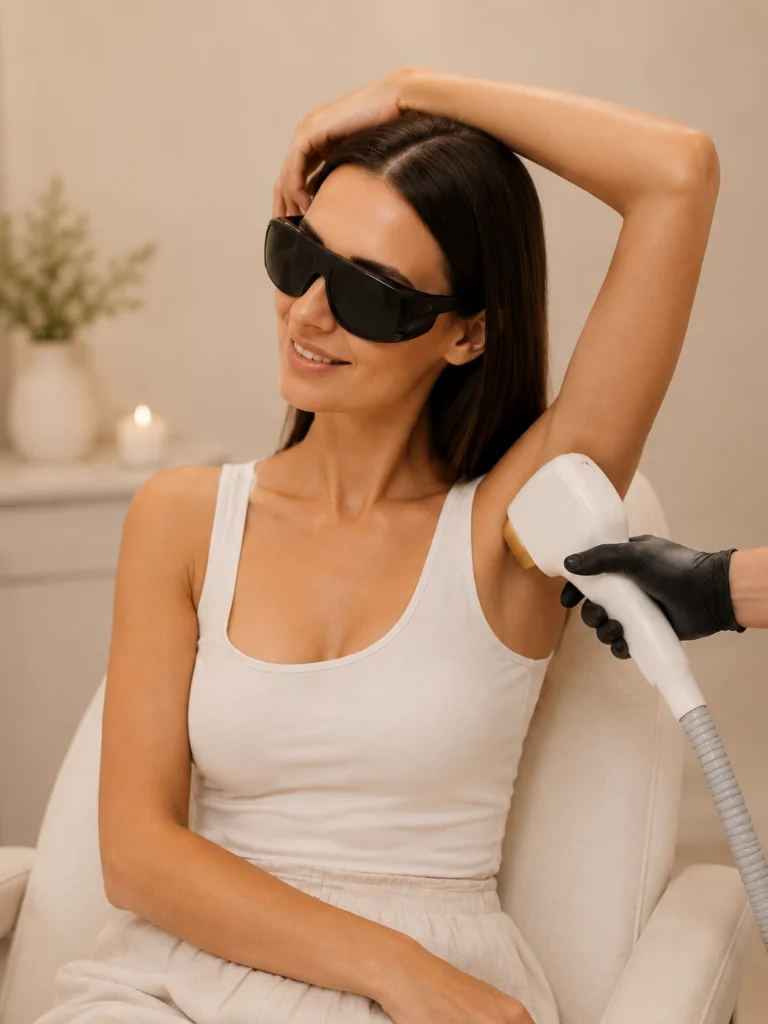
Your provider will hand you protective eyewear before the device is switched on, and it stays on until the last pulse. Sessions usually open with a few test pulses at a conservative setting so you know what is coming and your provider can watch how your skin responds before covering the full area.
Patients most often describe the sensation as a rubber band snapped against warm skin, followed immediately by a cold burst from the cooling spray. Bony areas and the upper lip register more sharply than the legs or the back. The pulses come quickly, and most people settle into the rhythm within the first minute or two. Numbing cream is available for anyone who would rather not find out how they handle it.
Session length depends entirely on the size of the area. An upper lip takes a couple of minutes. Underarms run five to ten. Full legs or a back can occupy 30 to 45 minutes. Two small habits make the appointment easier:
- Wear loose clothing that will not rub against the treated skin on the way home, particularly after a bikini or underarm session.
- Book the session with a clear evening after it rather than squeezing it in before an event, since mild redness for a few hours is normal and expected.
What happens to your skin in the days after?
Most patients leave with pink skin and small raised bumps around each follicle. That reaction is called perifollicular edema, and it signals that the laser reached its target. It usually settles within a few hours and almost always within a day. A cool compress helps, as does skipping hot showers and strenuous workouts for the first 24 hours.
The part that surprises people arrives about a week later. Treated hairs appear to keep growing for five to fourteen days, then work their way out of the skin and fall away. That is shedding, and it looks identical to regrowth from the outside. Gentle exfoliation with a washcloth helps the process along. Two habits protect your result between appointments:
- Apply broad spectrum sunscreen to any treated area that sees daylight, and keep applying it for the duration of your series.
- Shave whenever the hair bothers you between sessions, and leave the wax strips in the cabinet until your course is finished.
How many sessions will you need?
Most areas respond to a course of six to eight sessions, scheduled four to six weeks apart on the face and six to eight weeks apart on the body. That spacing follows the growth cycle, and the intervals often lengthen as treatment progresses because less active hair remains to catch. Coarse dark hair on lighter skin clears fastest. Fine or light hair responds more slowly, since there is less pigment for the laser to find.
Visible change usually shows up after the second or third session, when patients notice they are shaving less often and the hair that does return feels finer. Areas driven by hormones, such as the chin and jawline, often call for a maintenance visit once or twice a year after the initial course. You can see what completed treatment looks like in our before and after gallery and review current rates on our price list.
A full series is easier to budget when it is planned in advance rather than paid for one appointment at a time. Wright’s Med Spa offers membership options and flexible payment plans that spread the cost of a course across the months you will actually be in treatment.
Can laser hair removal help with ingrown hairs?
Yes, and for a good number of patients it is the reason they book at all. Ingrown hairs and the inflammation that follows them start when hair curls back into the skin after shaving or waxing. Removing the follicle removes the source of the problem rather than managing it week to week. Our guide to how laser therapy heals folliculitis and ingrown hairs covers what that process looks like for patients dealing with chronic irritation along the beard line or the bikini area.
Patients treating the face for both hair and texture concerns sometimes ask about combining appointments. Spacing matters here. Laser sessions and professional facial treatments in Bethlehem, Nazareth & Stroudsburg PA both ask something of the skin barrier, so your provider will sequence them across separate weeks rather than stacking them together.
Worth noting. A tan is the single most common reason a first appointment gets rescheduled. Skin that has seen recent sun or a bottle of self tanner carries extra pigment that competes with the hair for laser energy. If a beach weekend sits on your calendar, book your session for two to four weeks after you get back and let the color fade first. |
Frequently Asked Questions
Should I shave before my first laser hair removal session?
Yes. Shave the area with a fresh blade 24 to 48 hours before your appointment. The laser needs the follicle intact below the surface and the hair cleared above it.
How long before my session should I stop waxing?
Four to six weeks. Waxing pulls hair out at the root, and the root is what the laser targets. Shaving is the removal method to use during that window and throughout your course of treatment.
Does laser hair removal hurt?
Most patients compare it to a rubber band snapping against the skin, followed by a cold burst from the cooling device. Sensitive spots such as the upper lip and bikini line register more than the legs or arms. Numbing cream is available on request.
Is laser hair removal safe on darker skin?
Yes, when the device and the settings suit your skin tone. The Nd:YAG wavelength on the Candela platform reaches deeper skin tones safely because it passes through surface pigment instead of being absorbed by it. A test patch beforehand is standard practice.
What if I have a tan when my appointment arrives?
Call ahead. Treating tanned skin raises the risk of a burn or a pigment change, so most providers would rather move the appointment than dial the energy down and spend a session on settings too low to accomplish much.
How soon will I see results?
Shedding begins about a week after each session. Meaningful thinning usually becomes obvious after the second or third appointment, and the full picture takes the complete series.
Your first session starts with a conversation
The patients who have the smoothest first experience are the ones who asked their questions before the appointment rather than during it. A consultation gives your provider the chance to look at your skin and your hair in person and to set expectations that match what the laser can actually do for your particular combination of skin tone and hair color.
We welcome patients at our three Pennsylvania locations in Nazareth, Bethlehem, and Stroudsburg. When you are ready to start, contact us today to schedule your laser hair removal consultation and we will map out a plan built around your skin and your schedule.
References
Methods to Overcome Poor Response and Challenges of Facial Laser Hair Reduction. Journal of Clinical and Aesthetic Dermatology. pmc.ncbi.nlm.nih.gov/articles/PMC9239120
Laser Treatment in Hirsutism: An Update. National Library of Medicine, PMC. pmc.ncbi.nlm.nih.gov/articles/PMC7190465
Gentle Laser Treatments for Hair Removal. Candela Medical. candelamedical.com/patient/brands/gentle
